

Research reveals Microraptor could glide
February 3, 2026
Dr. Alex Dececchi and an international team of researchers have made another discovery related to dinosaurs and early flight. The team discovered how air flowed around the bodies of early multi-winged bird-like dinosaurs.
Dececchi, a paleontologist and assistant professor of biology, worked with the Chinese University of Hong Kong (CUHK)’s School of Life Sciences international research team on the project. This discovery builds on the research team’s long-term work.
“We’re looking at how these creatures moved and lived, including how they ran, jumped, and flew,” Dececchi said.
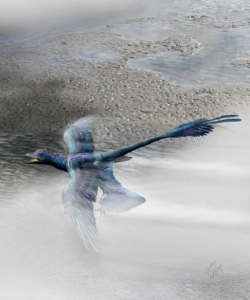
The research focused on Microraptors, a bird-like dinosaur from the Cretaceous period (about 143 to 66 million years ago) that had particularly large wings on its legs. This research provides a foundation for investigating the origins of early flapping-powered flight. These findings have been published in the prestigious journal PNAS.
Many early birds and their closest relatives had multi-wing systems that included the arms, legs, and tail. Today’s scientists still don’t know how the early multi-wing system functioned or why it evolved to the single wing system of today’s birds.
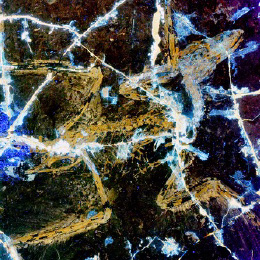
CUHK’s research team used anatomical insights from over 100 fossilized Microraptor specimens at the Shandong Tianyu Museum of Nature to reveal that the dinosaur’s four wings and tail worked together to help it fly. Swirling air pattern around the front edges and tips of wings, while air pushed down by the forelimb wings flowed over the hindlimb wings, which helped generate extra lift, Dececchi said.
The team used fundamental physics equations to simulate airflow. Dececchi’s role focused on inputs for the model, such as how big the wings are, how heavy the animal was, launch speeds, angle of the forelimb wings, hindlimb wings, and tail.
“This helps us understand how the forelimbs and hindlimbs interacted and what behaviors were and, more importantly, weren’t possible,” Dececchi explained. “In the air at this same time were early birds and pterosaurs, so understanding how Microraptors could have exploited the airways is important to see how they hunted in the ancient skies.”
The team is continuing to research early flight in winged dinosaurs. “Adding dynamic actions, such as flapping, is the next step,” Dececchi said.
The latest research follows the team’s 2024 discovery that small-feathered dinosaurs ran at speeds only achieved by using their wings to ‘flap-run.’