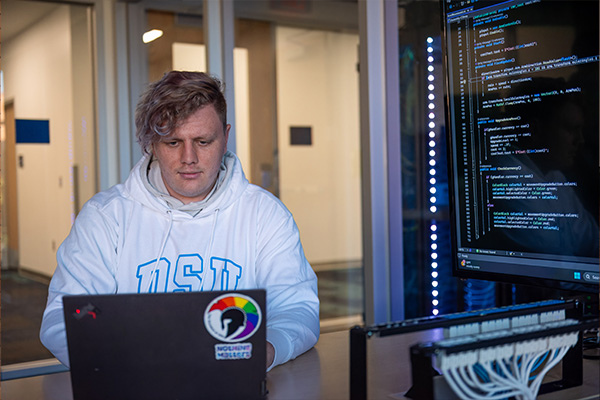

Data Privacy, MS
Program Quick Facts
Credits
30
Start Terms
Fall
|Spring
|Summer
Available
Online
Tuition
$3,365.10
estimated cost per semester
The Master of Science in Data Privacy prepares students to navigate one of today’s most urgent challenges—the protection, governance, and ethical use of data across government, corporate, and global environments. Designed for working professionals who are leading privacy programs or seeking to advance into new roles, the program welcomes students with diverse backgrounds, including business, law, policy, IT, cybersecurity, healthcare, and government. Delivered fully online, the flexible program can be completed from anywhere, as a full-time or part-time student.
MS in data privacy curriculum & experience highlights

Interdisciplinary approach to data privacy
The MSDP blends technical, legal, and organizational perspectives to prepare students for real-world privacy challenges. Coursework covers data governance, privacy-enhancing technologies, digital forensics, incident response, and major privacy laws and compliance frameworks. Students also build skills in risk management, policy development, and effective communication, enabling them to work across teams and create practical, organization-wide privacy strategies.
Real-world applications in technology
Students explore emerging topics such as advanced privacy technologies, AI governance, and secure data ecosystems. Through applied projects and research, they address real-world problems and develop solutions that meet privacy and cybersecurity needs, preparing them to lead in an evolving technological landscape. Project-based learning allows students to build skills in designing comprehensive privacy solutions, bridging the technical and policy domains in any industry.
How cyber defense differs from data privacy
| MS in Cyber Defense | MS in Data Privacy | |
|---|---|---|
| Primary Focus | Protecting systems, networks, and infrastructure from attacks, breaches, and disruptions. | Protecting information—ensuring data is collected, stored, and used in lawful, ethical, and transparent ways. |
| Core Skills | Vulnerability assessment, intrusion detection, penetration testing, digital forensics, incident response, cryptography. | Data governance, privacy compliance (GDPR/CCPA), privacy-by-design strategies, risk and program management, policy, and accountability. |
| Common Frameworks | NIST Cybersecurity Framework, IR and forensics standards, offensive and defensive security methodologies. | NIST Privacy Framework, GDPR, CCPA, AI and data protection regulations. |
| Overall Approach | Highly technical; focused on defense, detection, and response. | Organizational and regulatory; focused on responsible data use, policy, and trust. |
| Career Paths | Security Engineer, SOC Analyst, Penetration Tester, Digital Forensic Examiner, Incident Responder. | Privacy Analyst, Privacy Manager, GRC Manager, Data Protection Officer, Chief Privacy Officer. |
Why study data privacy at DSU?
A growing global need
Data privacy is crucial for digital transformation, AI innovation, cybersecurity, and regulations. Organizations must protect sensitive data while complying with complex laws. In South Dakota, key sectors like healthcare, finance, government, agriculture, and technology face workforce shortages. As the use of AI and advanced computing grows, privacy experts are vital for ethical data use. The MSDP helps address gaps in privacy expertise, preparing graduates for high-demand roles that support compliance and innovation.
DSU’s leadership in cyber & privacy education
Dakota State University is nationally recognized for excellence in cybersecurity, digital forensics, and cyber operations. The MSDP builds on this foundation by integrating DSU’s strengths in technology, policy, and applied research to prepare graduates to influence privacy legislation, governance, and emerging technology policy at national and global levels.

Faculty






Career opportunities in data privacy
The Master of Science in Data Privacy prepares graduates to lead organizations in data protection and compliance. As privacy continues to intersect with national security, technological innovation, and global policy, DSU graduates will be leaders in this vital field.

Your future at DSU begins today.
- A bachelor’s degree from an accredited institution.
- Minimum 3.0 GPA on a 4.0 scale (or equivalent)
- International applicants must have a degree equivalent to a U.S. four-year degree.
- No GRE is required.
Timelines & requirements
Next steps
Application deadlines
- August 15 (April 15 for international students) for admission the following fall semester
- November 30 (November 1 for international students )for the following spring semester
- April 30 for the following summer semester