Cyber Operations, MS
Program Quick Facts
Credits
30
Start Terms
Fall
|Spring
|Summer
Available
On Campus
|Online
Tuition
$3,365.10
estimated cost per semester
Enhance your education by pursuing a master's degree in cyber operations. This program is firmly grounded in computer science, emphasizing applied research, making it a perfect fit for those who want to deepen their expertise or are aiming to improve their skills in areas such as offensive and defensive cyber operations, critical infrastructure protection, and advanced cybersecurity techniques.
Through a rigorous, applied curriculum, you will broaden your knowledge in essential cyber operations skills, including reverse engineering, malware analysis, penetration testing, and software exploitation. This will equip you with the skills to evaluate various types of cyber vulnerabilities, ultimately helping to reduce organizational risk.
MSCO curriculum & experience highlights

Your path to high-demand roles
The cybersecurity sector is expected to experience significant growth both nationally and within South Dakota, signaling a strong demand for qualified professionals. Graduates of DSU’s cyber operations master’s program stand out in competitive job markets with opportunities for elevated salaries as they gain experience and advance in their careers. Advance even further with our cyber operations Ph.D. to lead the future of cyber operations.
Immersive cyber operations training
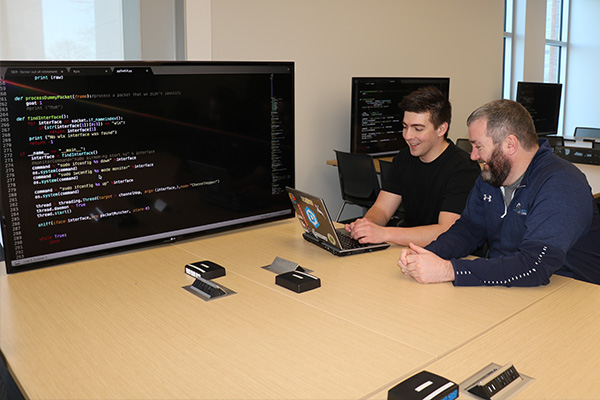
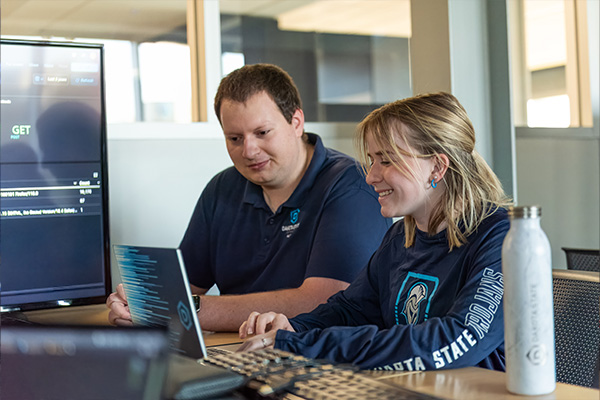
At DSU, you will work on real-world research projects that tackle today’s toughest cyber threats. This program will promote collaboration among students, faculty, and industry partners, supporting the overall mission to tackle emerging cyber threats and develop innovative solutions for businesses, government agencies, and the military. Plus, you will have the opportunity to train in DSU’s nationally recognized labs, that provides you with the opportunity to experience and build connections that will launch a powerful career in cybersecurity.
“Studying cyber operations at DSU has been both challenging and highly rewarding. The flexible format allowed me to balance my professional and family responsibilities while gaining hands-on experience that enhanced my technical expertise and effectiveness in my professional cyber roles.”
Walt Del Orbe, cyber operations student
Why choose DSU?
Graduate with recognized expertise
We are proud to be one of only ten universities in the nation that holds all three National Security Agency Center of Academic Excellence designations, including Cyber Operations (CAE-CO), making us one of only 22 institutions to achieve this prestigious recognition.
Affordable academic excellence
At DSU, we foster student success by combining academic excellence with affordability. Our cyber operations program is among the most affordable and one of the few to be offered fully online, allowing students to continue working while upskilling. Graduates are prepared to meet the demands of top employers and research labs without sacrificing quality, flexibility, or financial accessibility.
Notable courses
This course delves into advanced reverse engineering methodologies, encompassing multiple processor architectures such as x86/x64, ARM, and embedded devices. Students will gain proficiency in analyzing compiled binaries, interpreting disassembled code, and mastering Assembly language across diverse platforms. The course offers a systematic approach to reverse engineering, incorporating guided exercises in static and dynamic analysis, deobfuscation, and binary instrumentation. A key focus is on comprehending compiler optimizations, function recovery, and the security implications of software vulnerabilities.
This course provides advanced techniques for analyzing sophisticated malware encompassing all aspects of dynamic and static analysis, including decompilation and disassembly. It also includes anti-analysis bypasses, automation, and scripting. Students will examine a variety of recent malicious software samples and compose technical reports of their findings.
This course focuses on assembly language programming, specifically as it applies to reverse engineering and binary exploitation. The primary objective of this course is to prepare students for classes in those areas. Specifically, the course focuses on 64-bit x86 in a Linux environment. It may also discuss other architectures (ARM, MIPS, etc.) and environments (Windows, OS X, etc.).
This course delves into embedded platforms, covering software development, embedded architectures, and hardware interactions. Students gain hands-on experience programming embedded devices, working with various architectures, and interfacing with hardware components. This course includes peripheral communication protocols, memory management, and real-time constraints. Additionally, an emphasis is placed on firmware development, debugging, and troubleshooting hardware-software integration.
This course covers topics and techniques related to binary exploitation with a focus on memory corruption vulnerabilities. Exploit mitigations such as DEP and ASLR will be covered, including various methods of bypass. Other topics may include source code auditing, fuzzing, and debugging. Students entering this class should have strong knowledge of C and assembly programming.
Faculty
Use the Next and Previous buttons to page through faculty profiles. Use Tab to move through currently displayed profiles.








Become a leader in cyber operations
At DSU, we combine academic excellence with real-world impact. With government partnerships and cutting-edge research labs, you'll graduate with skills in reverse engineering, vulnerability assessment, ethical hacking, and more.
Your future at DSU begins today.
- A bachelor’s degree from an accredited institution.
- Minimum 3.0 GPA on a 4.0 scale (or equivalent)
- International applicants must have a degree equivalent to a U.S. four-year degree.
- No GRE is required.
Timelines & requirements
Next steps
Application deadlines
- August 15 (April 15 for international students) for admission the following fall semester
- November 30 (November 1 for international students )for the following spring semester
- April 30 for the following summer semester