

Military Articulation Agreements
At DSU, we recognize the depth of skill and experience military learners bring to the classroom. Through dedicated partnerships with the National Cryptologic University (NCU), U.S. Army Cyber Command (ARCYBER), the Army Cyber Center of Excellence (CCoE), and the Community College of the Air Force, we offer clear pathways to complete undergraduate and graduate degrees. These agreements help you receive credit for your training, reduce time to graduation, and connect you with cyber and intelligence programs built for working professionals.
On this page: UNDERGRAD GRADUATE UNDERGRAD & GRAD
Undergraduate degree agreements
Dakota State University partners with the National Cryptologic University (NCU) to offer a streamlined pathway for NCU students—particularly those completing the Joint Cyber Analysis Course (JCAC) or CYBR3420/CYBR3422—to earn a Bachelor of Science in Cyber Operations.
What this agreement provides
-
Up to 45 transfer credits accepted from JCAC, CYBR3420, or CYBR3422 toward the BS in Cyber Operations.
-
A clear pathway for NCU students to complete their degree online through DSU.
-
Waived requirements for:
-
High school transcript submission (based on military admissions standards)
-
Earning 15 of the final 30 credits at DSU
-
Credits you may receive
DSU awards academic credit for:
-
NCU coursework (JCAC and CYBR modules)
-
ACE-evaluated military coursework
-
Industry certifications, including A+, Network+, Security+, CISSP, Cisco ICND/CCNA, Juniper JNCIA
-
Nationally standardized exams such as AP, CLEP, and DSST
A full evaluation is completed upon receipt of official transcripts from NCU or other accredited institutions.
Remaining DSU degree requirements
To earn the Bachelor of Science in Cyber Operations, students must complete:
-
45 credits of DSU cyber operations major courses
-
30 credits of general education coursework
-
Exit exam prior to graduation
A total of 120 credits is required for degree completion.
Next Steps
- To participate in this articulation agreement, simply apply to DSU through the standard application process.
- After applying, submit your National Cryptologic University transcript, Joint Services Transcript (JST), and any college transcripts to the DSU Admissions Office.
- Once received, DSU will evaluate your transcripts based on the articulation agreement. Any additional service-based coursework not directly mapped will also be reviewed for potential credit.
Notes for applicants
-
USAF students with alternative cyber training (non-JCAC) may receive credits evaluated on a case-by-case basis.
-
NCU students admitted to DSU pay the standard off-campus tuition rate.
-
Transcript evaluation is required before an official credit transfer decision can be made
To request your National Cryptologic University transcript, use one of the following:
Mail:
Email:
Dakota State University partners with the Community College of the Air Force (CCAF) to provide a seamless transfer pathway for Airmen who want to complete the Bachelor of Science in Cyber Leadership and Intelligence (CLI).
Through this agreement, Airmen can apply their Air University Associate to Baccalaureate Cooperative (AU-ABC) coursework directly toward the DSU CLI degree.
Who is this for?
This pathway is ideal for Airmen who:
- Have completed (or are completing) an Associate in Applied Science (AAS) through CCAF
- Want a fast, efficient route to a bachelor’s degree
- Are pursuing careers in cybersecurity, intelligence analysis, cyber leadership, digital forensics, or national security fields
How the degree transfers
Under this agreement:
- Up to 51 credits from CCAF and AU-ABC apply directly to the degree
- Airmen who complete their CCAF associate degree automatically satisfy 15 of the 30 required general education credits
- Students must complete at least 30 credits from DSU to meet the university’s residency requirement
- You’ll complete the remaining program and specialization coursework online through DSU
Program structure
The 120-credit B.S. in Cyber Leadership and Intelligence includes:
1. Core & focus area (54 credits)- Includes:
- Intro to cyber leadership
- Cyber ethics
- Cybersecurity fundamentals
- Information security management
- Organizational communication or management
- U.S. and world affairs
- International relations
- Hardware & virtualization
- Computer science/cyber courses
Many technical courses—such as CSC 105, CSC 145, CSC 150, CSC 250, and others—may transfer in from CCAF.
2. Choose One Specialization (18 credits)
Digital Forensics:
Courses include operating environments, networking I & II, computer forensics, advanced forensics, and more.
OR
World Affairs & Human Behavior:
Courses include hacking & hacktivism, terrorism studies, comparative government, macroeconomics, digital media/intercultural communication, social deviance and more.
3. General Education (30 credits)
At least 15 credits are fulfilled by your CCAF associate degree.
4. Electives (18 credits)
Fully satisfied through CCAF credits.
Cost & tuition
Students pay DSU tuition based on their state of residency. Military students may use tuition assistance, and DSU provides support for navigating AU-ABC and military education benefits.
How to apply
- Apply to DSU through the standard undergraduate application.
- Submit official transcripts from:
- CCAF
- Any other colleges attended
- AU-ABC documentation (if applicable)
- Work with DSU admissions and advising to complete your transfer credit evaluation and degree plan.
Graduate degree agreements
Dakota State University partners with the National Cryptologic University (NCU) to provide a streamlined pathway for NCU students to earn the Master of Science in Computer Science (MSCS) with a specialization in Cyber Operations.
What this agreement provides
- Opportunity for qualified NCU students to apply select training toward the MSCS degree.
- Up to 12 graduate credits awarded for approved NCU coursework (including CYBR3420 and CYBR3422).
- A flexible path for students to complete remaining degree requirements fully online.
Credit evaluation & requirements
To earn the MSCS with a specialization in cyber operations, students must complete:
- 15 credits of DSU core graduate coursework, including:
- Algorithms
- Programming languages
- Operating systems & parallel programming
- Theory of computation
- Machine learning
- At least 1 cyber operations specialization course taken through DSU
- Up to 12 graduate credits may be satisfied through eligible NCU coursework
- 3 credits = 80 NCU contact hours (maximum of 12 credits)
- Coursework must be completed within the last 10 years unless currency is demonstrated
Students must also meet all DSU graduate admission and requirements, including any support coursework and the exit exam.
Admission notes
- Standard DSU graduate application required
- Letters of recommendation are waived for NCU applicants
- Applicants must submit:
- Joint Services Transcript (JST) and/or
- National Cryptologic University transcript
- Any additional graduate transcripts
- Tuition is charged according to the student’s state of residency.
Next steps for NCU applicants
To participate in the articulation pathway:
- Apply to DSU through the regular graduate application process.
- Send your transcripts to the DSU Graduate Admissions Office so your credits can be evaluated.
- DSU's Registrar will review your materials and prepare a credit evaluation based on this articulation agreement. Additional NCU coursework not directly mapped may still be reviewed for potential credit.
To request your National Cryptologic University transcript, use one of the following:
Mail:
Email:
Dakota State University partners with the National Security Agency’s National Cryptologic University (NCU) to expand educational opportunities for NCU students and provide efficient pathways to complete DSU undergraduate and graduate degrees. DSU and NCU review the agreement annually and update program mappings as needed. Students enrolled at the time of any change remain protected under their existing program requirements.
What this agreement provides
- Streamlined transfer pathways for NCU students entering select DSU degree programs:
- Cyber Operations, BS
- Computer Science, MS
- Cyber Defense, MS
- Computer Science, MS with a Specialization in Cyber Operations
- Recognition of coursework for academic credit when appropriate.
- Clear guidelines for how military and NCU training transfers into DSU programs.
Transfer credit allowances
- Up to 90 transfer credits toward a DSU bachelor’s degree (max 60 from two-year colleges).
- Of these, up to 45 credits may come from military training listed in the program appendices.
- Up to 12 graduate credits may transfer toward a DSU master’s program when applicable.
- Coursework more than 10 years old may still be accepted if currency can be demonstrated.
Admission requirements
NCU students must:
- Apply to DSU through the standard admissions process.
- Submit NCU transcripts, JST transcripts, and any other college transcripts.
- Meet all DSU and South Dakota Board of Regents admission and graduation requirements.
Military applicants:
- High school transcript/GED requirement is waived.
Tuition & fees
- Undergraduate active-duty service members and DoD civilians receive a $250/credit tuition rate with all fees waived.
- Graduate-level active-duty/nonresident DoD civilians are charged the graduate tuition rate, with fees waived.
- Explore more of the estimated cost & aid.
through an Educational Partnership Agreement to collaborate on advanced cyber research, innovation, and education.
This agreement connects DSU’s cyber strengths with ARCYBER’s operational mission, creating opportunities for students, faculty, and researchers to engage with real-world, defense-focused cyber challenges.
What this partnership means for students
Through this partnership, DSU students and faculty may:- Participate in defense-related research projects with ArCTIC, including cyber-peculiar science and technology work.
- Engage with ARCYBER practitioners who may mentor students, review research, or take part in labs, site visits, and seminars.
- Access unique labs and facilities (as appropriate and authorized), including ArCTIC’s innovation environment in the Augusta, GA area and DSU’s Madison Cyber Labs (MadLabs®).
- Explore thesis and dissertation topics aligned with real operational needs in cyber, DevSecOps, and advanced technology development.
- Collaborate on joint research proposals and knowledge-sharing events such as workshops, conferences, and briefings.
What DSU brings to the partnership
As a nationally recognized cyber institution and home to all three NSA/DHS National Centers of Academic Excellence in Cybersecurity designations, DSU:
- Provides faculty and research staff to co-lead projects and mentor students.
- Hosts research programs and lab sessions that ArCTIC experts can join as collaborators or technical advisors.
- Helps shape research directions, thesis ideas, and dissertation work in areas of mutual interest.
What ArCTIC brings to the partnership
ArCTIC supports DSU by:
- Identifying research efforts of mutual interest and involving DSU faculty, researchers, and students in those efforts.
- Providing access (when authorized and appropriate) to data, systems, and environments that support cyber-focused science and technology research.
- Promoting awareness of DSU research opportunities to ArCTIC personnel and encouraging their participation in DSU projects.
Undergraduate and graduate degree agreements
Dakota State University partners with the National Security Agency (NSA) through an Education Partnership Agreement designed to create unique learning and career-building opportunities in STEM fields—including cybersecurity, computer science, engineering, and data science.
Purpose of the partnership
As a DSU student, this agreement gives you access to opportunities that most universities can't offer, including:
- Hands-on experiences with NSA experts who may visit class, assist with course development, or support student projects.
- Participation in NSA-related research, where eligible students may contribute to real-world STEM challenges.
- Academic credit for approved work on NSA-supported projects.
- Career and academic guidance from NSA personnel familiar with federal cybersecurity and intelligence careers.
- Access to specialized equipment or instructional materials that NSA may loan or provide for DSU learning activities.
What DSU provides
DSU supports the partnership by:
- Creating STEM courses and projects that align with NSA interests and industry needs.
- Providing space and access for NSA personnel visiting campus or working with DSU teams.
- Connecting faculty, students, and NSA project leads to collaborate on approved activities.
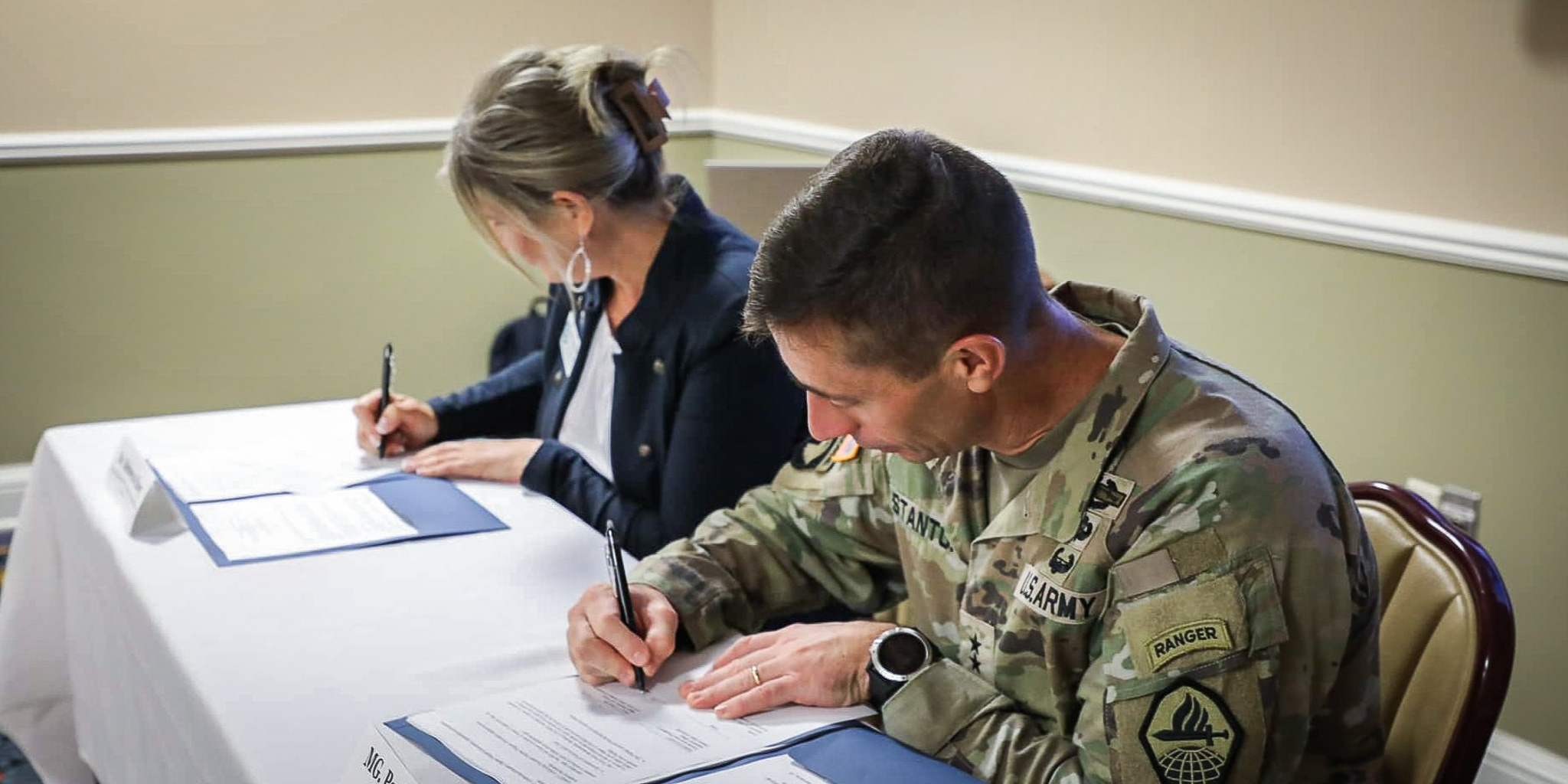
Dakota State University has a Memorandum of Understanding (MOU) with the United States Army Cyber Center of Excellence (CCoE) at Fort Gordon (formerly Fort Eisenhower) to help soldiers turn their Army cyber and signal training into progress toward DSU degrees—both undergraduate and graduate.
Who is eligible?
This agreement is designed for soldiers who:
- Are currently serving in the Department of the Army with one of the following MOS: 17A, 170A, 170B, 170D, 255A, 255N, 255S
- Or recently retired from one of these MOS (within three years of the agreement date)
- Have completed the appropriate MOS training courses at CCoE
- Can provide a Joint Services Transcript (JST) and course completion certificates
- Meet all DSU admission and degree requirements
DSU programs included
Eligible CCoE Soldiers can apply credit toward the following DSU programs:
Master’s degrees (although the MOU does not specify PhD programs, DSU will accept CCoE coursework for elective credits on a case-by-case basis):
- Master of Science in Artificial Intelligence
- Master of Science in Computer Science
- Master of Science in Cyber Defense
Bachelor’s degrees:
- Artificial Intelligence, BS
- Computer Science, BS
- Cyber Leadership and Intelligence, BS
- Cyber Operations, BS
- Cyber and Network Security, BS
(Each MOS maps to specific DSU courses within these programs, as outlined in the agreement.)
How does your army training transfer?
Depending on your MOS and courses completed at CCoE, you may receive significant DSU credit for:
- Technical courses (e.g., Intro to Computers, Intro to Cyber, Computer Science I & II, Networking I & II, Malware Analysis, Operating Environments)
- Cyber leadership and intelligence courses (e.g., Intro to Cyber Leadership, The U.S. Intelligence Community, Cyber Law and Policy)
- In some cases, general education courses such as Composition I & II and College Algebra
Delivery & support
Under this partnership, DSU will:
- Offer distance learning/online options so you can complete your degree from wherever you're stationed.
- Maintain academic advising and support services via phone, email, and online appointments.
- Provide library and research resources appropriate for your program.
- Help guide you through using ArmyIgnitEd for tuition assistance and registration.
Tuition & ArmyIgnitEd
- See current cost & aid at DSU.
- Your Service may pay up to $250 per credit hour through Army Tuition Assistance, per Army policy.
- You are responsible for any tuition above $250/credit.
How to Get Started
- Review programs you're interested in.
- Apply to DSU through the standard admissions process.
- Submit your JST and any course certificates so DSU can evaluate your training under this MOU.
- Work with a DSU advisor and your Education Services Officer (ESO) to align your degree plan and ArmyIgnitEd funding.