

AI Lab
The Artificial Intelligence (AI) Lab is committed to pioneering and conducting scientific research in the field of AI, as well as applying AI to significantly address the emerging challenges in various smart applications, such as security and privacy, Internet-of-Things (IoT) with 5G, edge computing, and others.
AI Lab Goals and Objectives
- Advance the development and application of state-of-the-art AI and machine learning models, incorporating the latest research to improve accuracy, efficiency, and applicability.
- Expand collaborations with industrial and business partners, leading to real-world projects that enhanced student learning, fostered innovation, and delivered tangible value to partners.
- Increase opportunities for student engagement in applied research through internships, industry-sponsored projects, and collaborative workshops.
- Expand outreach to the community through public workshops, training sessions, and engagement activities that promote AI literacy and showcase DSU’s expertise.
Key Outcomes and Accomplishments
DSU + AI Sweden
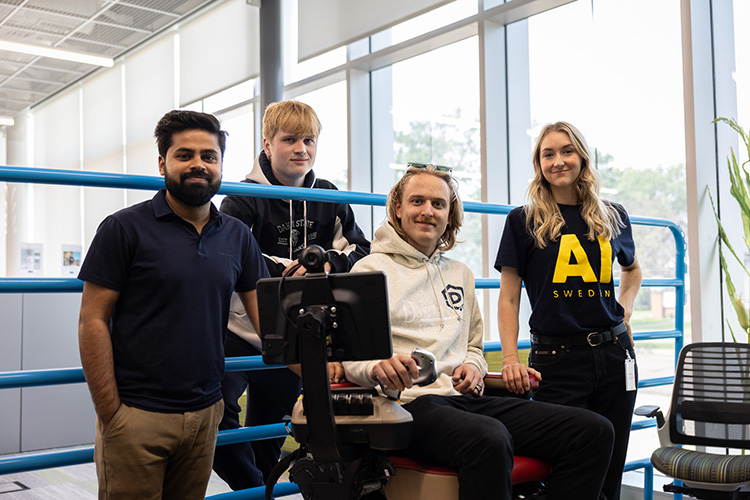
For the past four years, Dakota State University (DSU) and AI Sweden have successfully expanded an Industrial Immersion and Graduate Student Exchange Program. For the 2025 program, a cohort of 23 graduate students joined faculty, industry experts, and partners to tackle real-world challenges posed by prominent industrial organizations on problems at the intersection of Artificial Intelligence and Cybersecurity. The students work at AI Sweden’s office in Gothenburg during the month of June and at MadLabs in July.
2025 industrial sponsors
Analyze cybersecurity challenges within VGR’s digital operations to identify critical processes and IT systems, map AI-related risks, and develop data aligned with regulations such as NIS2 and the EU AI Act. The project will deliver concrete security recommendations and training resources to enhance cyber resilience, strengthen regional digital preparedness, and support sustainable and secure digitalization.
Develop a context-sensitive risk assessment tool that dynamically adjusts to new threats — utilizing real-world observations and up-to-date threat intelligence.
Develop a honeypot generator that deploys traps with prescribed vulnerabilities, LLM-generated content, and LLM-based simulated responses, alongside a RAG system that ingests vulnerability databases and labeled attack patterns to generate optimized honeypot configurations for learning emerging attacks.
Advanced applications of artificial intelligence and machine learning (AI/ML) in drone swarm systems. This project leverages multi-agent reinforcement learning (MARL) to coordinate a swarm of autonomous drones for threat detection and tracking in realistic simulations, with ongoing improvements to swarm behavior through dynamic role assignment and continuous training.
Develop an on-premise large language model (LLM) to assist CNH's recon and red team operations by automating reconnaissance, including fine-tuning and retrieval-augmented generation (RAG) setup.
For its pilot year (2024/2025) the program launched with three industry partners—SBS Cybersecurity, East River Electric Cooperative, and LifeScape. Each partner presented a specific challenge related to ongoing or emerging issues within their organization, encouraging student teams to develop proof-of-concept solutions (providing relevant data and resources as needed).
The SBS Deepfake Project demonstrated how available tools (e.g., DeepFace Live and ElevenLabs voice cloning) can be combined to create convincing real-time deepfakes on platforms such as Zoom and Teams. By showcasing the ease and low cost of deploying these technologies, the project raised awareness of their potential for misuse in blackmail, misinformation, and impersonation, and emphasized the urgent need for stronger safeguards.
The East River Electric Cooperative Project involved developing a predictive model using operational data to forecast regional power station needs. By guiding resource routing for optimal delivery, the model aims to reduce outages and lower operational costs.
The Predictive Analytics for Behavioral Incidents Project aims to develop an AI tool that can forecast when individuals in LifeScape’s care may be at risk of engaging in physical aggression toward staff. By enabling early detection of high-risk situations, the tool will help caregivers take proactive measures to improve safety and support for both staff and clients.

Jason Mixon
Assistant Professor
Department
The Beacom College of Computer & Cyber Sciences
Contact
Office Location: East Hall
Phone: (605) 256-5838
Email
Website

Austin O'Brien
Associate Professor / Dept. Chair - Computer Science
Department
The Beacom College of Computer & Cyber Sciences
Contact
Office Location: East Hall
Phone: (605) 256-5838
Email
Website

Mark Spanier
Associate Professor / Dept. Chair - Emerging Technologies
Department
The Beacom College of Computer & Cyber Sciences
Contact
Office Location: East Hall
Phone: (605) 256-5838
Email